
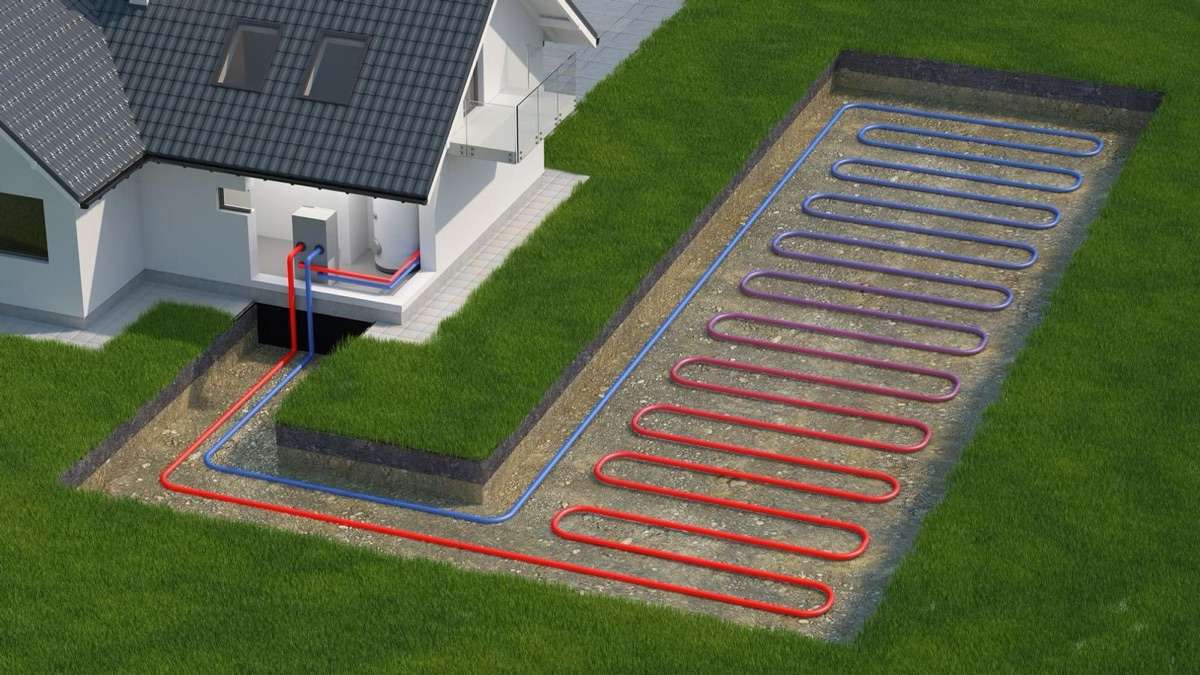
You can usually replace a geothermal heat pump without touching the ground loop, as long as the loop passes testing. The Department of Energy puts the indoor heat pump's average life at 20-plus years and the underground loop at 25 to 50 years, so many loops outlast their first unit. A technician pressure tests the loop, checks flow, antifreeze and entering water temperature, and confirms the loop is big enough for your home before the new unit is sized and connected.
Why the indoor unit wears out before the loop
A closed-loop geothermal system has two very different halves. Outside, buried pipe carries a water and antifreeze mix through the ground. It has no moving parts, it sits at a steady temperature and, once it's sealed and tested, there's little to wear out. Inside, the heat pump holds a compressor, a blower motor, refrigerant circuits, a water-to-refrigerant heat exchanger, circulating pumps and a control board, all of which run thousands of hours a year.
DOE's consumer guide reflects that split: it gives geothermal heat pumps an average 20-plus year life expectancy and the underground infrastructure 25 to 50 years. Northeast Ohio has a good number of systems installed in the 1990s and 2000s, so a lot of homeowners, especially people who bought a house that came with geothermal, are now facing an aging indoor unit attached to a loop that may have decades left.
Signs your geothermal heat pump is near the end
Age alone isn't a reason to replace a working system. These are the patterns that usually start the conversation:
- Backup heat running more every winter: If your electric bill climbs each January and the auxiliary heat light is on often, the compressor may no longer be carrying the load it used to.
- Compressor or refrigerant failures: A failed compressor or a refrigerant leak inside the unit on a system near 20 years old is often the point where repair stops making sense.
- Older refrigerant: If the nameplate lists R-22 (HCFC-22), you can still have it serviced, but the EPA notes that production and import ended January 1, 2020, so service relies on recovered or stockpiled refrigerant whose price and availability can change.
- Parts you can't get: Control boards, blower motors and flow center pumps for discontinued models can take weeks to find, which is a long time to run on backup heat.
- Comfort that slipped: Rooms that never quite get warm, short cycling or noise that wasn't there before can point to a unit that's worn, or one that was never sized right.
Testing the loop before you replace the geothermal unit
This is the step that decides the whole project, and it's worth doing before anyone quotes you a full system. A good loop check covers more than whether the pressure gauge reads something.
We pressure test the loop and watch whether it holds over time, since a slow drop points to a leak at a fitting, a header or the pipe itself. We measure flow through the loop and the temperature of the water entering and leaving the unit, which shows whether the ground is actually delivering heat. We check the antifreeze concentration, because a loop that's been topped off with plain water over the years can be at risk of freezing at the heat exchanger. And we purge air, which can mimic a pump or loop problem.
Finally, we compare the loop to the house. If the original installer cut the loop short, the old unit may have leaned on backup heat from day one, and a new unit won't fix that. Entering water temperatures in late winter tell us a lot about whether the loop has enough capacity.
What changes when the new unit goes in
A replacement isn't a straight swap of boxes. Your house may have changed since the first install: new windows, an addition, a finished basement or added insulation all change the heat load. We run a fresh heat loss calculation instead of copying the tonnage off the old nameplate, then match it against what the loop can supply.
The new unit's flow requirements have to fit the existing loop, so the flow center, which circulates the water and antifreeze through the ground, is often replaced at the same time. We'll also look at the ductwork, since a modern variable-speed unit may move air differently than the one it replaces, the electrical circuit for the unit and its auxiliary heat strips, and the thermostat. If the old unit had a desuperheater feeding your water heater, we reconnect or replace that loop as well.
Open-loop systems that use a well add their own checks: water quality, mineral scale in the old heat exchanger, the well pump and the discharge. Scale that clogged the old unit will do the same to a new one unless the cause is addressed.
When the loop itself needs work
Sometimes the test finds a problem in the yard. A leak at an accessible fitting or header in the basement or near the foundation can often be repaired. A leak somewhere along a buried run is harder; it may mean isolating and abandoning one circuit, adding a bore or trench, or in rare cases rebuilding the loop.
An undersized loop is a different kind of problem. If the numbers show the loop can't keep up with your home in deep winter, the options are adding loop capacity, accepting more backup heat, or tightening up the house so it needs less heat. We'll explain what we found, show you the readings, and price the options separately so you can decide.
Cost and timing for a geothermal unit replacement
A unit-only job is a fraction of a full geothermal install, because the most expensive work, drilling or trenching the loop, was paid for years ago. What moves the price is the unit's capacity and features, whether the flow center and ductwork need changes, the electrical work and any loop repair the testing turns up.
There's no federal tax credit to factor in for 2026: the IRS states the Residential Clean Energy Credit (25D) is not available for property placed in service after December 31, 2025. Timing still matters. If the testing shows the unit is close to failing, replacing it in spring or fall, rather than during a January breakdown, keeps your house off backup heat and gives you time to compare options. Our 2026 incentives guide covers what Ohio programs are and aren't available.
How Echols handles a geothermal replacement
We start with a diagnostic visit on the existing system, not a sales pitch. If the unit can be repaired for a reasonable price, we'll say so; our geothermal repair service page covers the common fixes. If replacement makes more sense, you get the loop readings, a written price for the new unit and any related work, and a clear explanation of why we sized it the way we did.
Echols is a WaterFurnace GeoPro dealer. After the new unit is running, a yearly visit on one of our service plans includes loop pressure checks, which is the easiest way to catch a slow leak before it becomes a no-heat call. Call (234) 248-2777 to schedule a loop and unit evaluation.