
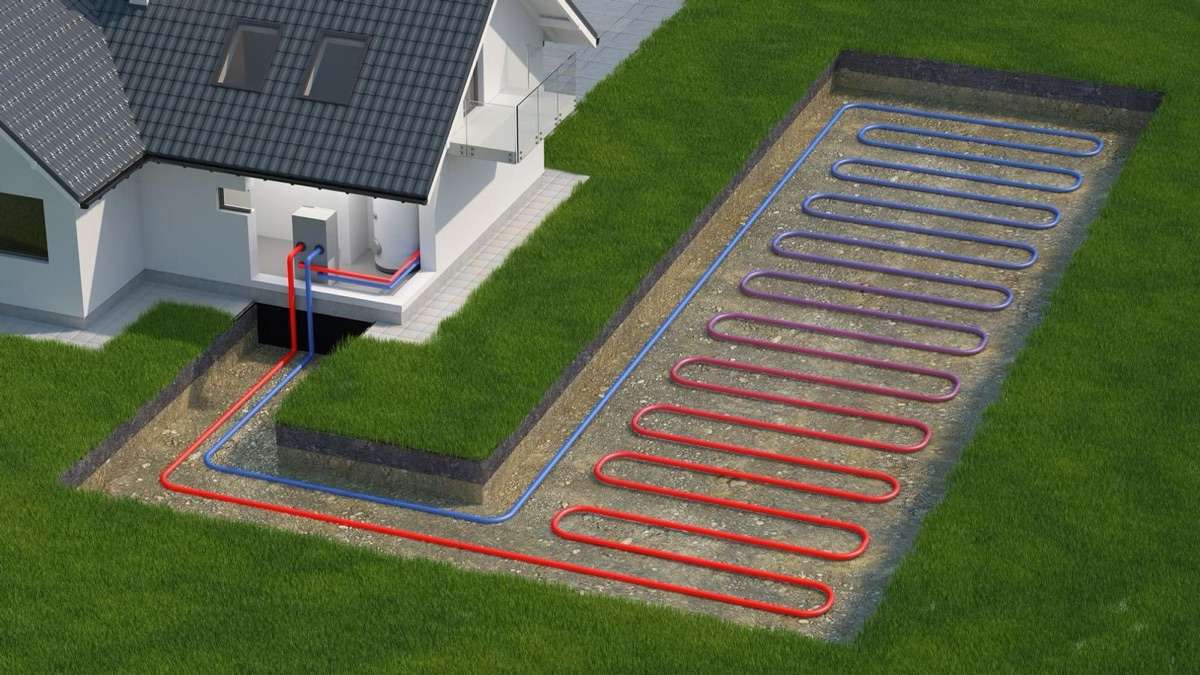
Geothermal cost in Ohio depends mostly on the ground loop (vertical bores, horizontal trenches or a pond loop), then on your home's heating load and the condition of your ductwork. The U.S. Department of Energy says a geothermal system costs more to install than an air-source system but can recover the difference in energy savings in 5 to 10 years. With the federal 25D credit gone for systems installed after December 31, 2025, that payback math matters more than it used to.
Why geothermal costs more up front than other heating
A furnace or an air-source heat pump is one or two boxes and some ductwork. A geothermal system adds a third part that the others don't have: a sealed loop of pipe buried in your yard, filled with water and antifreeze, that trades heat with the ground. Drilling or trenching that loop, connecting it to the house and pressure testing it is where most of the extra money goes.
The Department of Energy's consumer guide gives a sense of scale. It puts the geothermal heat pump itself at about $2,500 per ton of capacity, so roughly $7,500 for a 3-ton unit before installation and drilling, compared with about $4,000 for a comparable air-source heat pump with air conditioning. Treat those as national, 2021-era equipment figures, not an Ohio installed price and not an Echols price: they leave out the loop work, which is usually the largest line on a real quote.
What you get for that money is a system that does not depend on outdoor air temperature. A few feet down, the ground stays at a fairly steady temperature all year, warmer than January air and cooler than July air, and the heat pump works from that steady source instead of fighting the weather.
The ground loop is the biggest geothermal cost driver
DOE describes four loop types, and which one fits your property sets the tone for the whole quote. Your lot size, soil and rock, any pond on the property and local rules on groundwater all narrow the choice before price comes into it.
- Vertical closed loop: Bores drilled deep into the ground, each holding a U-shaped pipe. DOE notes these can cost more but use the least land and disturb the least landscape, which is why they suit most suburban lots around Akron.
- Horizontal closed loop: Pipe laid in trenches at least four feet deep. DOE calls this generally the most cost-effective residential option where there's enough open land, so it shows up more on larger rural parcels.
- Pond or lake loop: Coils sunk at least eight feet below the surface of a body of water that meets volume, depth and quality criteria. DOE says it may be the least expensive option when a suitable pond exists.
- Open loop: Well water runs through the heat pump and returns to the ground or a surface outlet. It only works with an adequate supply of reasonably clean water and where local discharge rules allow it.
Other things that move a geothermal quote in Northeast Ohio
After the loop, the size of the job comes down to your house. A heat loss calculation, room by room, tells us how many tons of capacity you need. A drafty 1950s colonial and a tight newer build with the same square footage can need very different equipment, and every extra ton means more loop as well as a bigger heat pump.
Ductwork is the next question. Geothermal units deliver long, steady runs of moderately warm air, and ducts that were sized for an old high-temperature furnace can be too small or too leaky to carry it quietly. Some homes need only sealing and a few changes; others need new trunk lines. Homes heated by radiators or baseboard have no ducts at all, which changes the project entirely.
Smaller items add up too: the electrical circuit for the heat pump and its backup heat strips, a desuperheater to preheat domestic hot water, removing the old furnace and air conditioner, a new thermostat, and putting the yard back to rough grade after the drilling or trenching rig leaves.
What you get back: efficiency and lifespan
The case for geothermal rests on operating cost and longevity, and DOE's numbers on both are strong. Its consumer guide says geothermal systems can reduce energy consumption by 25 to 50 percent compared with air-source heat pump systems and reach efficiencies of 300 to 600 percent on the coldest winter nights, meaning they move three to six units of heat for each unit of electricity they use. ENERGY STAR reports that certified geothermal heat pumps are, on average, over 45 percent more energy efficient than standard options.
Lifespan matters just as much to the math. DOE gives the indoor heat pump an average life of 20-plus years and the underground loop 25 to 50 years. That means the expensive part of the job, the loop, can serve a second and even third indoor unit, and replacing a worn-out unit on a sound loop later costs far less than the first install.
Is geothermal worth it in Ohio? How to run the numbers
Northeast Ohio sits in IECC climate zone 5A, which the Pacific Northwest National Laboratory classifies as a cold climate. Long heating seasons are exactly where a ground source system earns its keep, because it heats efficiently on days when an air-source unit is struggling. Whether that makes it worth it for your house depends on a few questions only you can answer.
First, what do you heat with today? Homes on propane or electric resistance heat, which are common on rural lots in Medina and Portage counties, usually see the biggest drop in operating cost. Homes on natural gas save less per year, so the payback stretches out. Second, how long will you stay? DOE's 5 to 10 year payback estimate only helps you if you're still in the house when it's reached. Third, does your property suit an affordable loop? A big open lot or a good pond changes the numbers in your favor; a small lot over hard rock does not.
If you're building new or already replacing both your furnace and air conditioner, DOE points out that geothermal is a particularly good fit, since you were going to spend money on heating and cooling equipment anyway. Our geothermal installation page walks through how we size and plan a new system.
What changed in 2026: no federal tax credit for homes
Until the end of 2025, the federal Residential Clean Energy Credit (Section 25D) covered 30 percent of a qualifying geothermal heat pump installation. The IRS now states that the credit is not available for any property placed in service after December 31, 2025, and its FAQ adds that an expenditure counts as made when installation is completed. A deposit paid in 2025 for a system finished in 2026 does not qualify.
That removes a large discount many older articles and quotes still assume, so check any figure you've seen elsewhere. Business-owned systems fall under a different federal credit; DOE lists the commercial Section 48 investment tax credit for geothermal heat pumps as still in place, and a tax advisor should confirm whether it applies to you. For the full picture of what's left, including Ohio utility programs, see our 2026 guide to HVAC tax credits and rebates in Ohio.
How to get a real geothermal price for your property
Because the loop depends on your land, nobody can give you an honest geothermal number over the phone. We start with a visit: a heat loss calculation, a look at your ductwork and electrical panel, and a walk around the property to see where a loop could go. Then we lay out the loop options that fit, explain why we'd pick one, and give you a written price for the whole job, coordinating the drilling or trenching for you.
Echols Heating & Air Conditioning is a WaterFurnace GeoPro dealer, and our geothermal heating and cooling page covers the service and repair side. If the up-front cost is the sticking point, we work with multiple financing sources; our financing page explains the options. Call (234) 248-2777 to set up a site visit.
Sources
- DOE Consumer Guide to Geothermal Heat Pumps (cost per ton, 5-10 year payback, 25-50% savings, 300-600% efficiency, lifespans, loop types)
- ENERGY STAR: certified geothermal heat pumps over 45% more efficient than standard options
- DOE Energy Saver: Heat pumps (geothermal expensive to install, pays back over time)
- IRS: Residential Clean Energy Credit not available for property placed in service after Dec. 31, 2025
- IRS FAQs on 25C/25D changes under Public Law 119-21 (expenditure made when installation is completed)
- DOE: Tax credits and incentives for geothermal heat pumps (commercial Section 48 ITC)
- PNNL Guide to Determining Climate Zone by County (Summit County, OH: zone 5A, cold)